


Cobl for consulting firms
Win the deal before the work begins.
The client judges you before a consultant has worked a day. Cobl helps you answer more opportunities, faster, without taking over partners’ evenings.




The Problem
What costs a firm its engagements
The weekend proposal, written by the partner.
First meeting on Thursday, proposal expected on Monday. The partner writes it between two projects, on Sunday evening. That is the most expensive person in the firm, on a task that does not bill, at an hour when they no longer think well. Utilization suffers, so does quality.
A recycled proposal reads like a recycled proposal.
You open last month's, change the client name, adjust the price. The client sees it on page two: the understanding of the context is generic, the approach is the same as for their competitor. They conclude the engagement will be too.
The junior writes a draft. The client expects a partner.
A manager or a consultant can put a proposal together. What is missing is what experience brings: what to put forward, how to frame the approach, what matters to this client. The draft goes up, the partner rewrites it. Two days lost, and back to problem number one.
What the client said in the meeting never makes it into the document.
The client's words, their real stakes, what they said between the lines about their executive committee: it is all in the meeting notes, the follow-up email, the partner's head. When it does not make it into the proposal, the proposal comes out accurate and cold. The client does not recognize themselves.
Three offices, three practices, three ways to write the same proposal.
Every partner has their own template, every practice its vocabulary, every office its deck. A client who consults two teams from the same firm gets two different firms. The house standard lives in the founders' heads, not in the documents.
How it works
More engagements won, without the partner at night
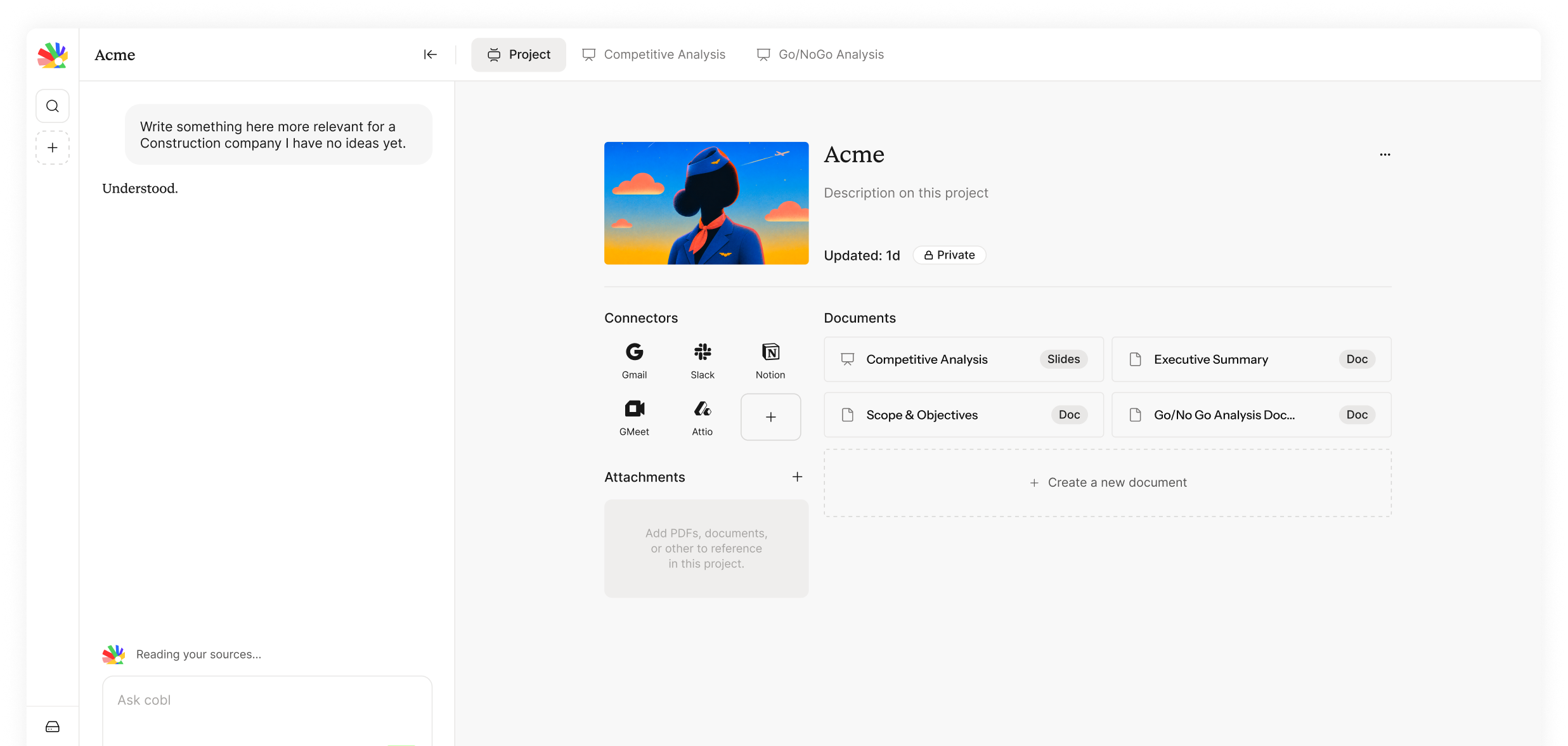
A pursuit always follows the same path: understand, frame, propose, price, sign. Cobl takes the writing at every step. The partner keeps the framing and the relationship.

The meeting becomes the brief
Paste the meeting notes, the transcript or the client's email. Cobl pulls out the stakes, the client's words, the decision makers, the scope, the calendar. The understanding of the context is written with what the client said, not with a generic paragraph.

Your methodology and your won engagements set the standard
Proposal templates, approaches by type of engagement, references, CVs, brand guidelines. Uploaded once. Every proposal picks up the firm's structure and tone. The client gets the same firm, whatever the office or the practice.

The proposal is written at partner level, from the first draft
Understanding of the context, framing of the problem, approach by phase, deliverables, team, schedule, budget. Written from the meeting and from comparable won engagements. A manager runs the generation, the partner reviews for an hour and adjusts the framing. The document goes out in 48 hours.
The pitch deck and the RFP response follow
The presentation deck is built from the proposal. If the client runs a formal RFP, the response uses the same base in the imposed framework. The partner goes back to their project, the firm answers more opportunities with the same seniors.
Sales, pre-sales and experts on the same system
Econocom's Director of AI and Innovation: diverse teams, no professional writers, producing to the same standard.

“Our teams are very diverse. We don’t have professional writers or development capabilities, so the ability to rely on AI to understand the context and make the process accessible to everyone is a real advantage.”

300%
ROI
300+
users in 6 countries
€100k
saved in 6 months
FAQ
Everything you need to know about partnering with Cobl

Each team reviews its part in the same document. The account lead validates the whole. No merging of Word files, no "final v7".
No. Eligibility stays in your network tools, pricing in your configurator. Cobl uses the results (technology, bandwidth, lead time, price per site) in the proposal when you give them to it.
Offer sheets, SLAs, repair times and terms live in the base in one version. When they change, every new proposal uses the current version. Old proposals stay archived as they were.
Yes. You drop in the site list and the requirements. The proposal is structured site by site and service by service, and picks up the needs of each site.
Yes. That is the Free Pro use case: a complete response goes from several days to two hours. The volume is absorbed by the shared base, not by extra hours.
Most teams are generating real proposals within their first session. Onboarding is built around your existing content, upload what you already have, and Cobl starts working from it immediately. No long implementation and no long IT project.
Cobl offers private cloud and on-premise deployment for teams with strict data requirements. Your content stays within your infrastructure.
Cobl generates from a shared, validated content base, so every contributor draws from the same source. Tone, structure, and technical depth stay consistent across the whole document regardless of how many people are involved. The output reflects the firm's standard, not whoever happened to write that section this week.
Yes, that's the core of how it works. You upload your past proposals, security questionnaire answers, service descriptions, and reference cases. Cobl builds a knowledge base from them and draws on it for every new response. Your best work compounds across every proposal instead of being rebuilt every time.
Yes. Registration questionnaires and framework agreement responses use the same base. What was validated once is reused for every new lot or call-off.
Yes. Private base per company, no model training on your data, rights per project. The Security page details the commitments.
Each section is reviewed by its contributor (pre-sales, architect, legal, CISO). The bid manager tracks progress and validates the whole. The document stays one document, with one voice.
Yes. You drop in the grid (Word, Excel, PDF), Cobl fills in each point from your base. Compliance matrix, CVs in the imposed format and annexes follow the same template.
Our IT services customers go from two or three weeks to less than a week on a complete response. The gain comes from the writing and the assembly, not from the response strategy, which stays with your teams.
No. The deal stays managed in HubSpot or Salesforce. Cobl reads the CRM and produces what the deal has to send at every step.
Yes. Manager validation before anything goes out, if you want it. Quality stays at the team's standard, whichever rep wrote it.
You paste the transcript (Gong, Modjo, Fireflies, Teams) or your notes. Cobl pulls out the decision makers, the pain points, the criteria and the deadlines, and reuses them in every deliverable.
Yes. Cobl picks up the qualification fields from your CRM and the structure of your won deals. If your process calls for a mutual action plan or a business case, it produces it in that format.
Yes. Cobl is built for the rep who runs 15 deals at once, not for a response team. You paste a transcript, you get the recap, the proposal or the business case. The rest of your day stays yours.
On Cobl's free plan, you get around 5 documents free per month, no credit card required, enough to run Cobl on real deals in your pipeline.
Generic AI tools often generate text without knowing your deal, your past wins, or your pricing rules. Cobl is proposal management SaaS built from your business content, so the output is a sendable, on-brand document, not a draft to rebuild.
Yes. SaaS deals involve sales, presales, and management, and Cobl is built for that workflow: contributors work on their sections, and managers review and validate before anything goes out, so quality stays consistent no matter who drafted it. You can also invite as many teammates to your workspace on our Pro plan.
Most RFP content is 60–80% reusable across bids. Cobl retrieves your best past answers, adapts them to the new bid's context and required structure, and assembles all the documents needed for the response.
Yes, Cobl integrates with many CRM platforms, including HubSpot and Salesforce. Sign up to our platform to discover all of our CRM integrations.
SaaS proposal software generates and manages the documents that carry a software deal - sales proposals, RFP responses, and decks, pulling context from your CRM, reusing content from past wins, and producing branded, account-specific output. Cobl goes further: it builds each document from your actual deal data.
Yes. Your base is private, your documents are not used to train any model, and access is limited to your users. The Security page details the commitments.
No. The price schedule and the cost study stay in your tools. Cobl writes the documents and uses your figures in the proposal when you give them to it.
Same thing. You drop in the client's form or questionnaire, Cobl fills it in from your base. Answers already validated on another RFP are reused.
Yes. Rules, contract terms, technical specs, price schedules, DC1, DC2, DC4 forms, DUME, certificates. Cobl reads the RFP pack and prepares the response documents, in the framework imposed by the client.
Yes. That is the target. The project lead or the owner drops in the RFP pack, reviews the proposal, exports. No response team to build, no technical profile to hire.
Cobl offers 3 plans: Free, Pro, and Enterprise. The Free plan lets you sign up instantly with no credit card required and gives you a month with up to 1,500 credits, enough to test Cobl on a real RFP response before committing. The Pro plan scales with your volume, from 200 to 20,000 credits a month, suited to teams responding to RFPs regularly. For construction firms handling bids at volume or needing custom setup, the Enterprise plan is tailored to your workflow. Book a call with our team to discuss your needs.
Yes, provided the AI platform is built with security and data control at its core, which is exactly how Cobl is designed. On the efficiency side, the gains are real: teams cut technical brief drafting from days to hours because most of any RFP response already exists in past bids. On the security side, Cobl protects your data with AES-256 encryption at rest, TLS 1.2+ in transit, and 24/7 monitoring with automated alerts. Your documents are never used to train AI models, no fine-tuning, no data reuse, no hidden training, and Cobl only selects LLM providers that commit to no training or fine-tuning on your inputs. For construction firms handling confidential project data, Cobl also offers flexible deployment in sovereign, private, or on-premise clouds, including hosting directly in your own AWS or Azure tenant or running fully inside your infrastructure with no internet connection required. AI does the assembly; your experts keep control of validation and final review.
To write a construction proposal, structure it in six parts: project understanding, technical approach, team and references, timeline, pricing, and compliance documents. Start by restating the client's requirements in their own terms, evaluators score relevance, not length. Then detail your methodology, safety measures, and comparable past projects. The fastest way to do this consistently is to reuse validated content from previous winning bids rather than writing from scratch: most of a strong proposal already exists in responses you've written before.
Cobl pulls data from your past documents, CRM, and uploaded files into construction quotes and proposals, and exports to Word, PowerPoint, or PDF depending on what the RFP requires. RFPs rarely accept a single format. You might need a PDF technical brief, Word-based supplier approval forms, and an editable pricing annex. A platform that reads and outputs multiple formats saves the reformatting hours that usually happen the night before a deadline.
Cobl builds construction RFP responses and proposals while connecting directly to your CRM, so client details, contacts, and deal context flow into every document automatically. Instead of copy-pasting company names and project references from a spreadsheet, your response pulls the right client information from the systems you already use, reducing errors on the administrative forms where a wrong detail can disqualify a bid.
An RFP (request for proposal) in construction is a formal document a client or public body issues to invite contractors to bid on a project, detailing the scope, technical requirements, timeline, and evaluation criteria. Most construction RFPs require a technical brief, pricing documents, and administrative forms. Responding well means proving both technical capability and reliability, which is why RFP responses are among the most time-consuming documents construction teams produce.
Yes. Private base per firm, no model training on your data, rights per user. The Security page details the commitments.
You give the days and the daily rates, Cobl builds the budget by phase and by profile in the proposal. The pricing rule stays yours.
You paste the meeting notes, the transcript or the email. Cobl pulls out the stakes, the client's words and the scope, and uses them in the understanding of the context and the approach.
Yes. You upload your templates and your approaches by type of engagement. Cobl uses them, with your tone and your brand. The document comes out as a proposal from your firm, not as a template.
Yes. The target is the firm where partners still write the proposals. A manager runs the generation, the partner reviews. No pre-sales team to build.
ChatGPT gives you text that needs significant rework to become a sendable document. Gamma gives you generic slides. Cobl generates a complete, structured, branded proposal, built from your specific client context, that's ready to send without copy-pasting or reformatting. The output quality is the difference.
You get around 5 proposals free per month, with no credit card required. That's enough to generate real proposals for real engagements and see whether the quality improvement is there.
Yes. Mid-sized and larger firms use Cobl to standardize proposal quality across all consultants, so every submission reflects the same standard regardless of who creates it. You can upload shared brand guidelines, methodology frameworks, and past winning proposals as a firm-wide knowledge base.
Yes. Cobl offers private cloud and on-premise deployment for firms with strict confidentiality or data sovereignty requirements, so your client data stays inside your own infrastructure
Most sample proposals for consulting services are too generic to use: wrong structure, wrong scope, wrong tone for your specific client. Cobl generates a proposal for consulting services from your own discovery call, so what you get is already specific, branded, and ready to send, not a sample to heavily edit.
The best proposal software for consultants generates client-specific proposals from your actual discovery context, not generic templates. Cobl builds each proposal from your call transcripts, client brief, and methodology, so it reads like you built it specifically for that client. Most consultants send their first proposal for consulting services the same day they sign up.
Cobl generates proposals that are more complete, more client-specific, and better structured than what most consulting firms produce manually or with generic AI tools. In complex deals, buyers score on exactly those criteria, so a stronger proposal scores higher and improves your win rate on competitive engagements.
Every deal deserves the right move. Make it.
Cobl runs your deals with full context: follow-ups, proposals, entire RFP responses, at the right moment.